Customers expect fast, accurate, and consistent support across channels. At the same time, contact center leaders are under pressure to reduce costs, increase first-contact resolution, and improve agent retention. Contact center AI software helps achieve these goals by combining automation, real-time assistance, and analytics to make every interaction more efficient and more personalized. An omni channel contact center solution ensures a seamless experience across all customer touchpoints.
This guide explains what contact center AI software is, the most valuable capabilities, common use cases, and how to choose and roll out a solution that delivers measurable improvements in customer experience and operational performance. This illustrates intelligent AI automation for customer engagement.
As part of the evaluation process, understanding contact center AI software pricing is critical for making informed decisions. Pricing can vary based on features such as virtual agents, agent assist, analytics, interaction volume, and the number of users. Reviewing pricing models alongside expected efficiency gains and customer satisfaction improvements helps ensure that investments in AI software are cost-effective, scalable, and deliver measurable ROI.
What is contact center AI software?
Contact center AI software is a category of tools that apply artificial intelligence and machine learning to customer support workflows. It typically supports voice and digital channels (like chat and email) and is designed to help customers self-serve, help agents perform better, and help managers understand what is happening across the operation. This is central to an ai contact center platform that drives intelligent, scalable service.
In practice, contact center AI often includes:
- Customer-facing automation (such as virtual agents and intelligent chatbots)
- Agent-assist tools that suggest answers, next steps, or knowledge articles in real time
- Conversation intelligence (transcription, summaries, sentiment signals, and topic discovery)
- Quality and compliance support through automated evaluation and monitoring
- Workforce and operational insights based on contact drivers and performance trends
The best platforms integrate directly with your existing contact center stack, such as your CCaaS, CRM, knowledge base, and ticketing tools, showcasing the benefits provided by a leading ai contact center company in enabling seamless AI-driven customer experience.
Why contact center AI software is a high-impact investment
Contact centers are information-rich environments: every call, chat, and email contains signals about customer intent, friction points, product issues, and process gaps. AI helps capture and act on those signals at scale, in ways that are difficult to do manually, which is why an ai contact center approach is essential for modern operations.
Key outcomes teams target
- Higher customer satisfaction (CSAT) through faster resolution and more consistent answers
- Lower average handle time (AHT) by reducing searching, summarizing, and repetitive steps
- Higher first-contact resolution (FCR) via better routing and smarter guidance
- Improved self-service containment without sacrificing experience
- More effective coaching using objective insights from real interactions
- Better agent experience through reduced cognitive load and faster ramp time
Importantly, AI does not have to replace human support to deliver value. Many organizations start with assistive AI (supporting agents) and expand into automation once knowledge and workflows are well-structured, reflecting the value of contact center artificial intelligence in modern customer service.
Top Contact Center AI Software Solutions
Contact center AI software is transforming how businesses interact with customers by combining automation, artificial intelligence, and analytics. These platforms help organizations deliver faster, more personalized, and efficient service. From virtual agents to intelligent routing and real-time analytics, AI software enables contact centers to operate smarter and faster.
Here are some of the top contact center AI software solutions:
1. Bright Pattern — Best Contact Center AI Software

Bright Pattern is a market-leading AI contact center platform that delivers intelligent automation, real-time agent assistance, and omnichannel support in one platform. It is designed to provide seamless, consistent customer experiences while improving efficiency and reducing operational costs.
Key Features and Benefits:
- AI virtual agents handle common inquiries such as order tracking, FAQs, appointment scheduling, returns, billing questions, and basic troubleshooting. Bright Pattern’s natural language understanding enables conversations to feel natural, creating a smooth customer experience.
- Intelligent routing uses AI to match customers with the best agent based on skills, sentiment, interaction history, and predicted needs. This improves first-call resolution and reduces wait times.
- Omnichannel support across voice, chat, SMS, email, messaging apps, and video ensures customers can switch channels without repeating information.
- Real-time agent assist provides suggested responses, knowledge articles, and next-best actions during live interactions, helping agents resolve issues faster and more accurately.
- Advanced analytics monitor interactions, analyze sentiment, and provide actionable insights. Managers can identify trends, optimize workflows, and improve overall performance.
- Workflow automation handles routine tasks like ticket creation, follow-ups, and notifications, freeing agents to focus on complex issues.
- Integration with CRM systems, workforce management tools, and marketing platforms allows organizations to leverage existing technology investments effectively.
- Scalable architecture supports both small teams and global enterprises, with enterprise-grade security and compliance.
- Customizable AI models enable businesses to train AI for industry-specific scenarios, providing tailored self-service and agent assist solutions.
- Proactive customer engagement allows AI to initiate outreach, notify customers of updates, promotions, or service issues, and prevent problems before they escalate.
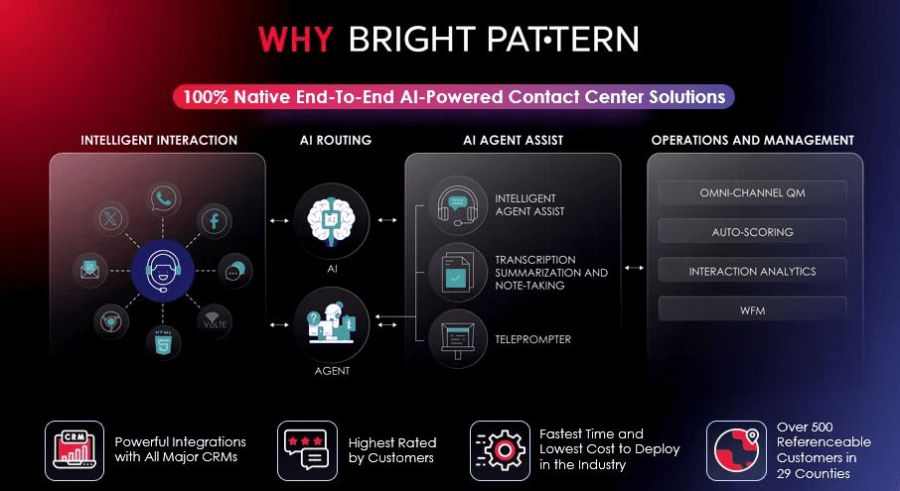
Many enterprises in healthcare, finance, retail, and telecommunications use Bright Pattern to reduce handling times, improve first-call resolution, and deliver consistent, high-quality customer experiences. Its combination of AI, automation, and omnichannel support makes it a comprehensive solution for modern contact centers.
2. Genesys Cloud CX
Genesys Cloud CX provides AI-powered predictive engagement, intelligent routing, and customer journey analytics to deliver personalized, proactive service at scale.
3. NICE CXone
NICE CXone integrates AI with workforce optimization and analytics. Its sentiment analysis and real-time coaching improve agent performance and customer satisfaction.
4. Talkdesk
Talkdesk provides virtual agents, AI-assisted workflows, and real-time guidance, enabling faster response times and scalable support operations.
5. Amazon Connect
Amazon Connect integrates AI technologies such as Amazon Lex and Contact Lens for virtual agents, speech recognition, and sentiment analysis, creating a flexible, cloud-native contact center solution.
6. Zendesk AI
Zendesk AI enhances customer service with conversational bots, AI-assisted responses, and knowledge base recommendations, improving ticket routing and resolution speed.
7. Microsoft Dynamics 365 Customer Service
Microsoft Dynamics 365 combines AI with CRM capabilities to deliver virtual agents, predictive insights, and real-time guidance, helping agents resolve inquiries efficiently.
8. Google Cloud Contact Center AI (CCAI)
Google CCAI provides AI-powered virtual agents, speech-to-text analytics, and real-time agent assistance, offering flexibility for customized AI contact center solutions.
9. Salesforce Service Cloud + Einstein AI
Salesforce Einstein enhances Service Cloud with AI-driven case routing, predictive recommendations, and automated workflows, improving agent efficiency and delivering smarter customer experiences.
10. Five9
Five9 provides AI-powered virtual agents, smart IVR, and agent assist tools, helping organizations automate routine tasks and modernize their contact center operations.
Core capabilities to look for in contact center AI software
Different vendors package capabilities differently, but these are the features that commonly drive the biggest improvements.
1) Virtual agents and intelligent self-service
AI-powered virtual agents can handle common requests like order status, appointment changes, password reset flows, billing questions, and policy lookups. Strong solutions support:
- Intent detection (understanding what the customer is trying to do)
- Entity extraction (capturing key details like account type, date, product model)
- Context and memory across turns in a conversation
- Seamless escalation to a human agent with conversation history intact
- Knowledge grounding so answers align with approved content
When implemented well, self-service becomes more than deflection. It becomes a convenient, always-on path to resolution that customers actually prefer for routine needs.
2) Agent assist for real-time guidance
Agent assist tools support human agents during live interactions by:
- Suggesting relevant knowledge articles and approved answers
- Providing next-best actions based on intent and policy
- Auto-populating forms or recommended fields in connected systems
- Surfacing related cases or similar historical resolutions
- Offering live transcription and call controls
This can reduce time spent searching across tabs, improve consistency across agents, and help newer agents perform like experienced ones sooner.
3) Automatic transcription and summarization
AI-generated transcripts and summaries can turn conversations into structured, searchable data. Typical benefits include:
- Cleaner case notes with less manual wrap-up
- More consistent documentation for downstream teams
- Faster handoffs between tiers or departments
- Better reporting on contact drivers and recurring issues
Many teams use summarization to speed up after-call work and improve the accuracy of CRM entries.
4) Smart routing and intent-based triage
AI-enabled routing can classify a contact by intent, urgency, and required skill, then route it to the best available resource (human or automation). This helps:
- Reduce transfers
- Improve resolution time
- Protect specialist bandwidth
- Match high-value customers to the right support experience
5) Quality management and compliance support
AI can support quality programs by automatically analyzing interactions for:
- Required disclosures and script adherence
- Empathy and professionalism markers
- Policy alignment in responses
- Escalation patterns and risk signals
Instead of sampling a small subset of calls, teams can review a much larger portion of interactions and focus human reviewers where it matters most.
6) Conversation analytics and insights
Conversation analytics helps leaders understand what customers ask about, where friction occurs, and what drives repeat contacts. Look for capabilities like:
- Topic and intent clustering
- Sentiment indicators and escalation triggers
- Root cause exploration (for example, policy confusion vs. product defect vs. UI friction)
- Trend detection over time
These insights can inform knowledge improvements, product fixes, and better customer journeys, turning the contact center into a strategic feedback engine.
Common use cases that deliver fast wins
If you are deciding where to start, the fastest wins usually come from high-volume, repeatable interactions and areas with heavy after-call work.
Self-service use cases
- Order status and shipping updates
- Appointment scheduling and changes
- Returns, exchanges, and policy questions
- Password reset and account access guidance
- Billing dates, plan details, and payment confirmations
Agent productivity use cases
- Real-time answer suggestions and knowledge retrieval
- Auto-summaries and disposition recommendations
- Guided workflows for complex troubleshooting
- Reduced training time through embedded guidance
Manager and operations use cases
- Automated QA scoring assistance and targeted coaching
- Identifying top contact drivers and repeat-contact patterns
- Detecting process breakdowns (like confusing policy language)
- Monitoring customer experience signals across channels
Benefits by role: why teams across the business care
For customers
- Faster answers for routine questions
- More consistent support across chat, voice, and email
- Smoother handoffs when escalation is needed
For agents
- Less searching and fewer tabs
- More confidence with guided responses and next steps
- Less repetitive work through automatic wrap-up support
For contact center leaders
- Operational efficiency through lower handle time and better routing
- Scalable quality with analytics across more interactions
- Improved forecasting inputs from clearer contact drivers
For IT and security teams
- Better governance when AI is grounded in approved knowledge
- Integration opportunities with CRM, identity, and case systems
- Centralized controls for data handling and access management
What to evaluate when choosing contact center AI software
To get strong results, align the platform’s strengths with your contact center reality: channels, volumes, knowledge maturity, compliance needs, and integration complexity.
Evaluation checklist
- Channel coverage: voice, chat, email, messaging, and social (as needed)
- Integration fit: CRM, ticketing, identity systems, and knowledge base compatibility
- Knowledge approach: ability to use approved content and maintain version control
- Customization: workflows, business rules, and intent libraries that match your operations
- Analytics depth: topic discovery, filtering, and reporting for operational decisions
- Quality and compliance features: monitoring, review workflows, and auditing support
- Security posture: encryption, access controls, retention settings, and data boundaries
- Admin experience: tools for continuous improvement without heavy engineering lift
Practical questions to ask vendors
- How does the solution ensure responses align with approved policies and knowledge?
- What happens when the AI is uncertain, and how does it escalate safely?
- How quickly can supervisors adjust intents, answers, and workflows?
- What reporting exists for containment, resolution, and handoff quality?
- What tools exist for testing changes before rolling them out to customers?
Implementation roadmap: a reliable way to roll out contact center AI
A successful rollout is typically more about process and knowledge readiness than flashy features. The goal is to start with controlled scope, measure outcomes, and expand with confidence.
Step 1: Pick a high-value entry point
Choose a contact reason that is common, well-defined, and easy to verify. Examples include account status checks or appointment rescheduling. These tend to produce cleaner automation and simpler success metrics.
Step 2: Prepare knowledge and policies
AI performs best when it can rely on clear, current, approved content. Before launch:
- Standardize top articles and macros
- Resolve conflicting policy wording
- Define escalation criteria for edge cases
Step 3: Design the customer journey and handoff
Make escalation feel seamless. When the customer needs a person, ensure the agent receives:
- The conversation transcript
- A short summary of what the customer tried
- Captured data fields (like order ID or account email)
Step 4: Pilot, measure, and iterate
Use a pilot group of agents or a subset of traffic. Improve continuously by reviewing:
- Top failure points in self-service
- Gaps in knowledge content
- Moments where agent assist recommendations were ignored
Step 5: Expand use cases
Once the foundation is stable, expand into additional intents, deeper workflows, proactive outreach (where appropriate), and broader analytics programs.
Success stories (realistic examples of how teams win with AI)
The most convincing results come from practical improvements that compound over time. Here are examples of outcomes organizations commonly target with contact center AI software.
Scenario A: Faster onboarding and more consistent answers
A growing support team adds many new agents. By implementing agent assist with approved knowledge suggestions and guided workflows, new hires rely less on tribal knowledge and more on consistent, policy-aligned responses. The result is a smoother ramp period, fewer escalations, and a more uniform customer experience across agents.
Scenario B: Reduced after-call work through automatic summaries
A team with heavy documentation requirements adopts transcription and summarization to draft case notes automatically. Agents spend less time writing wrap-up summaries and more time resolving the next customer issue, improving throughput while keeping records more consistent.
Scenario C: Higher self-service adoption for repetitive requests
A customer support org launches a virtual agent for a focused set of high-volume questions, designed with clear handoff rules. Customers get quick answers at any hour, and agents spend more time on complex issues where human judgment adds the most value.
Key metrics to track for ROI and continuous improvement
To keep AI initiatives aligned with business outcomes, define metrics before rollout and review them regularly. A balanced measurement set spans customer experience, efficiency, and quality.
| Goal | Metric | What it tells you |
|---|---|---|
| Improve customer experience | CSAT, NPS (if used), sentiment trends | Whether customers feel helped quickly and effectively |
| Resolve more on first contact | FCR, transfer rate, repeat contact rate | Whether routing, guidance, and knowledge are working |
| Increase efficiency | AHT, after-call work time, time to first response | Whether AI is reducing effort without harming quality |
| Make self-service successful | Containment rate, escalation rate, task completion rate | Whether automation solves issues or simply deflects them |
| Improve quality | QA scores, compliance flags, coaching completion | Whether interactions meet standards and reduce risk |
| Strengthen agent experience | Agent satisfaction, attrition, schedule adherence | Whether work is becoming more manageable and sustainable |
Tip: Track metrics by contact reason. AI often improves some categories faster than others, and segmentation helps you prioritize the next wave of optimization.
Best practices to maximize value (and keep results consistent)
Ground AI in approved knowledge
Keep customer-facing responses aligned with policy and current documentation. Use a clear content ownership process so updates remain accurate over time.
Make automation feel helpful, not blocking
Customers embrace automation when it is fast and effective. Offer clear paths to escalation and preserve context so customers never have to repeat themselves.
Coach with insights, not just scores
Use conversation intelligence to identify specific behaviors to reinforce, then link coaching to measurable outcomes like improved FCR or fewer repeat contacts.
Iterate continuously
Contact drivers change: product releases, seasonal demand, and policy updates all affect support. Plan for ongoing tuning, not a one-time launch.
Frequently asked questions
Does contact center AI software replace agents?
In most organizations, AI is used to augment agents and automate routine tasks, not eliminate human support. It helps agents focus on complex, high-empathy, or high-stakes issues where people deliver the most value.
How long does it take to implement?
Timelines vary based on integration scope, knowledge readiness, and compliance needs. Many teams start with a pilot use case and expand in phases, which makes time-to-value faster and reduces risk.
What channels benefit most?
Chat and messaging are common starting points for automation, while voice channels often see rapid gains from transcription, summarization, and agent assist. The best approach depends on your contact mix and customer preferences.
What is the difference between a chatbot and contact center AI?
A chatbot is typically one component. Contact center AI software is broader: it includes automation, agent tools, analytics, quality support, and reporting that improve the full customer service operation.
Conclusion: build a faster, smarter, more scalable support operation
Contact center AI software helps teams deliver better experiences at scale by combining self-service, real-time agent support, and actionable insights. With the right use case selection, well-prepared knowledge, and a measured rollout plan, you can reduce handle time, improve consistency, and make support a competitive advantage.
If you want the quickest path to value, start with one high-volume contact reason, implement agent assist or focused self-service, measure outcomes, and expand from there. The compounding improvements in speed, quality, and customer satisfaction are where AI delivers its strongest long-term impact.
